THE DANGER OF BELIEF IN NOTHING

QUOTES FROM ATHEISTS

Julian Barnes (Atheist novelist)
“I don’t believe in God, but I miss Him.”
Nothing to Be Frightened Of

Jean-Paul Sartre
“That God does not exist, I cannot deny. That my whole being cries out for God, I cannot forget.”
Nausea

Bertrand Russell
“The centre of me is always and eternally a terrible pain—a curious, wild pain—a searching for something beyond what the world contains.”
Letter to Constance Malleson, 1916

Woody Allen
“I’m not afraid of death—I just don’t want to be there when it happens.”
Without Feathers

PERSONAL REFLECTION

Let me start with my own heart and share what I see from within. I have not been one that has dealt with severe loss of human life around me. I have seen death, and I have witnessed the suffering of others, but personally I have been blessed to have lived these 40 years, and those I love still live. You may say that I am blessed, but what I can tell you is that this creates a fear within me. Deep inside there is a voice that says, “One day you will suffer greatly in this way.”

I look around and see suffering on every side—people I have met, people I have heard of, people I don’t even know. I see the mothers of the lost children in Texas today suffering, and I cannot fathom the loss they must feel. When I even ponder the idea of my son missing in that way or my mother on her deathbed, my heart breaks within me, and even writing this now, tears form in my eyes at the thought.

We cannot deny that in our world, although proven to be unique among the stars and a true treasure of the universe, there is great suffering among the living.

I believe it drives the heart to one of two places:
Men seek meaning, or men deny meaning altogether.

Great pain drives decisions. I know of many old men who lay on their deathbeds. Their physical bodies filled with pain—pain they have felt and dealt with for many years before. I know the saying of these men as they approach what they know to be the end of life statistically. My hero (and I will leave his name from this article) once said to me, and I will never forget it: “I used to think the pain would be more than I could bear, but I think the grace of God has allowed me to get used to it.”

Another great man said to me—a man who has experienced loss that would drive a grown man to tears at the very thought of it—”I am not good enough to be accepted by God, but death is a scary thought.”

I have witnessed the frantic struggles of men without hope as they passed alone to the other side of time, and I have witnessed the peace of those who had hope. And the thing that scares me the most is to live my life without hope. The faith it would require of me to believe in nothing is beyond my ability. And because I believe there is a God, I must seek to know Him.

This leaves me in a place that I despise in my heart: the idea of religion.

I find religion to be a disheartening and fear-driven entity that drives many to a place of hopelessness once it is explored. The vastness of its ideology is more than any man can fathom. The quantity of ways one can have hope is beyond the mind’s capabilities to comprehend. I was born with a heritage, however, but not many of my friends had the luxury of the heritage I have. Some do not know or see how they were born of spiritual fathers and mothers into the world in which they have hope.

I know many who, because of the great sea of confusion that surrounds hope, have turned to hopelessness and dogmatic beliefs in the lack of evidence of a supreme being and have found themselves lost in the sea of the forgotten, claiming power over themselves as if hopelessness was and should be a place for the hopeful.


HOW CAN I FOLLOW YOU TO THIS PLACE OF HOPELESSNESS KNOWING WHAT I KNOW NOW?

I have asked this question so many times to so many atheists, and the result 100% of the time is simply laughter. They somehow believe that mocking is an answer to the question. I have found that the black and cold heart of the atheist brings me much pain, and in that pain I am forced into decision:

  • Determine the atheist a fool, as the Scripture has determined already, and leave them where they stand.
  • Reach for them in the darkness so that they too can see the light which was shown to me.

I war with this decision. Somehow within me, I always find myself reaching for their hearts and trying to shed light into the darkness they have been lost in.


HOPE IS FREE

I do not know the argument that would suffice for the blind man who cannot hear. I do not know the evidence to use to show him the path. I want him to feel, but pain has made the heart numb. I want him to taste, but their taste buds are overwhelmed by bitterness. Even pure logic escapes the senses of the spiritually catatonic.

I often question how one can choose the idea of nothing as a foundation for their thoughts. How can one look around and see art and beauty, children and skies, wander through the vast universe and its complexity, and lay a foundation of nothing—yet give credit to human artists when they do the things they love?

How can we deny the power of a supreme designer?
But they do.

Discover more from The Unseen Thread

Subscribe to get the latest posts sent to your email.


27 responses to “THE DANGER OF BELIEF IN NOTHING”

  1. The Danger of Believing That Atheists Believe In Nothing! 😮

    Liked by 1 person

    1. Hi Archon, thank you for the commenting. Feel free to share here. The floor is always open for discussion. Do you feel that Atheists believe in something and that the faith of no faith has faith?

      Like

      1. Nah…. Despite my warning, you still couch your questions and comments on unverified assumptions. You’ll just have to wait – or not – until I publish my rebuttal, on the last Wednesday in November. 😮

        Like

      2. Your warning?
        Am I supposed to be concerned or something?
        You realize that threats coming from men who believe in nothing are only filled with the contents of their belief.

        Like

      3. If your cat has kittens in the barn, you can call them horses if you want. Just don’t be surprised when others point and laugh. 😮

        Like

      4. Agreed, that is literally my article in a nutshell.
        No trouble, I was only confused by the threat.

        Like

  2. I apologize if you’ve already dealt with these points in the comments – I’m far too lazy to read all of that. I see you’ve been busy, these past few days. :p

    “in our world, although proven to be unique among the stars and a true treasure of the universe”

    Our Earth is not unique, and our Sun is not unique. Rather than bore you with reports from NASA / JWST data, etc, I recommend watching this Epic Spaceman video – a truly great representation. I recognize that this was mostly just flowery language on your part, but I see this as indicative of one the main problem theists suffer from. That is: They value flowery language and the comforting image it provides literally more than the factual basis for said language. With all due respect, you’re ostensibly just saying a thing that is demonstrably untrue because it sounds nice and/or helps your current argument.

    “The faith it would require of me to believe in nothing is beyond my ability.”
    “I often question how one can choose the idea of nothing as a foundation for their thoughts. How can one look around and see art and beauty, children and skies, wander through the vast universe and its complexity, and lay a foundation of nothing”

    Atheists don’t need faith – this is a baseless, tiresome tu quoque fallacy. Don’t feel the need to read it, but I go into it here, and especially applicable, in your 2nd quote, is you holding hostage things we value as a species without justification. Essentially: “You’re not allowed to appreciate art unless you’re religious”. One could argue that it’s an appeal to emotion.

    “HOW CAN I FOLLOW YOU TO THIS PLACE OF HOPELESSNESS KNOWING WHAT I KNOW NOW?”

    This is another fallacy: Loaded question. It’s little wonder your question was laughed at.
    You seem to imagine that not being spiritual is inherently hopeless. That’s a “you” problem, not me as an atheist. Don’t assume my motivations and perceptions are the same as yours. Is there logically anything that would stop a materialist from also being an existentialist? Is there any contradiction in reason?

    No, there is not. Else I wouldn’t be both, myself.

    In the same vein: Is there a contradiction in theists when they claim to have an objective morality, and then they argue with each other about the correct *interpretations* of their *preferred* translation of their *preferred* denomination of their *preferred* religion?

    Yes. It’s all opinion, no matter how you slice it. You’re as much an existentialist as I. We all have subjective morality. Atheists merely admit to it.

    You didn’t push moral objectivity much in your writing, but I thought I’d mention it – mostly based on your title. I don’t believe in nothing. Indeed: I’d wager my ‘code’ if you will is stronger than that of any theists, for the simple fact that I wasn’t simply told/expected/forced to believe it. I came to my values through my own introspection and reflection.

    Like

    1. Thank you for your comment — and for the honesty in not reading the rest of the thread.

      Fair enough!

      My other Atheist friend is similarly(to both of us) long winded but from what I could see once you read one of his comments you had read them all. 😊 Let’s dig in.

      1. “Earth is not unique”
      You’re right that in purely physical terms, Earth and our Sun share traits with many other celestial bodies. But when I say Earth is “unique,” I mean more than composition or location. I mean the presence of life, sentience, consciousness, and moral awareness — things that, to date, remain completely unique to Earth despite our expanding telescopic reach. Flowery? Maybe. False? No. A treasure isn’t defined by rarity alone, but by value — and I would argue life is the most valuable phenomenon in the known universe.

      2. “Theists prefer comforting language to facts”
      You suggest I’m sacrificing truth for poetry. I disagree. I’m pointing to something deeper than facts: meaning. Science tells us how things are. Faith and philosophy wrestle with why. If you mistake that domain for ignorance or evasion, you’ll miss the actual argument: that a world brimming with beauty begs a deeper foundation than mere accident.

      3. “Atheists don’t need faith”
      This is a semantic point, but a vital one. I don’t mean “faith” as blind belief, but as confidence in something not fully provable. Atheism, especially the belief that everything arose from nothing, requires just as much explanatory risk as theism — often more. You call that “reason,” I call it unexamined trust in a narrative that sounds neutral but carries deep metaphysical assumptions.

      4. “You’re not allowed to appreciate art unless you’re religious”
      That’s not what I said — nor what I meant. My point is that the experience of art, love, awe, justice, and wonder all point beyond themselves. You can certainly appreciate them as an atheist. What I challenge is this: can a worldview built on impersonal matter and chance account for why we should value them?

      5. “Loaded question – hopelessness”
      If you felt that question was unfair, I understand. But I didn’t pose it to trap atheists — I posed it as a former one. For me, atheism led to despair. Not because atheists are hopeless, but because a worldview that reduces life to accident, consciousness to chemistry, and morality to preference left me unable to justify any transcendent meaning. If you’ve built something solid without that, I don’t begrudge you. But I will still ask — lovingly — whether it’s solid enough when the storms come.

      6. “Subjective morality is better because it’s chosen”
      This is a noble idea — but shaky ground. If morality is truly subjective, what stops your “introspective code” from being invalidated by someone else’s “introspective code” that includes genocide? You may never do such things — but on what basis do you say it’s wrong besides personal or cultural preference? We theists argue not that our behavior is perfect, but that morality has an anchor outside ourselves — and that anchor is God.

      Lastly, I don’t think you believe in “nothing.” You clearly care, you reflect deeply, and I respect that. But the point of the article — and the poem that follows — is to ask: What have you won, if your worldview ends in dust, death, and unresolvable subjectivity?

      You may not agree, and that’s okay. But know that this wasn’t written to mock atheism — it was written to mourn what it cannot give.

      Grace and peace to you.

      Liked by 1 person

      1. Yes – verbosity is certainly a weakness of mine. :p I appreciate you taking it in stride.

        1. “True treasure of the universe” is a subjective claim, sure. But “Proven” (it absolutely has not and literally *could* not have been proven unless we saw every exoplanet) and “unique” (in this context) are factual claims – both false.

            You go on to suggest, “I mean the presence of life, sentience, consciousness, and moral awareness”

            Again, I feel like you attempted to walk back what you said a little, only to shoot forward again. Nobody has proven life or sentience or morality doesn’t exist outside of our solar system, and indeed: Experts in the field find the possibility of alien life – even intelligent – highly probable. In fact, it was only a few months ago I think that they vastly increased the estimated number of planets in our galaxy alone with planets which could harbor life. Studies from Kepler put it at “at least” 300 million potentially habitable planets.

            2. “You suggest I’m sacrificing truth for poetry.”

            That’s a very good way of putting that. I may steal it when it inevitably comes up again in my other conversations with theists. And yes, I do. There is no other way to read #1 than exactly that.

            3. “but as confidence in something not fully provable.”

            Why is that your standard? “Fully” provable?

            If given a choice between something which you know has a 51% probability of truth, and another with 49%, then it is a fact that IF you care about truth, you should have a higher degree of certainty in the first choice (Kant’s hypothetical imperative). That is not to say “confidence” and absolutely not “certainty”.

            However, now increase that first probability to 6-sigma confidence. That is *not* quite 100% certainty, and yet it would be justified in being essentially “certain” in the claimed outcome. No metaphysics required. This is simply rational.

            I’m not sure if you’re one of those who could talk my ear off about “scientism”. If so, I look forward to that verbal tussle.

            4. Fair enough.

            “can a worldview built on impersonal matter and chance account for why we should value them”

            Yes. When I look at certain pieces of art my dopamine spikes. As I finally learned “Naked as we came” by Iron and Wine on guitar today, my dopamine spiked. If you boil it down: All anybody cares about, theist or not, is happiness. If art and music and architecture brings us joy via dopamine, then of course we should value them.

            5. “For me, atheism led to despair.”

            Again, mate, that’s a “you” problem – not a problem with the actual worldview. I don’t mean to sound like I’m dismissing your experience – I’m sorry you went through that – but my point is that it doesn’t prove anything, and only offers evidence of bias on your part why you’re now a theist.

            “morality to preference”

            We’ll get into it more, but even the staunchest of Christian *does* have a preference morality. They abide only by that which they *want* to abide by – that which they have rationalized as correct – in the religion/denomination/translation/interpretation which they subjectively decided was right. Premarital sex, divorce, not touching pig skin, not eating shellfish? “Na – those aren’t for me. I’ll stick with the adultery, lying, murder and other stuff that human society already knew was wrong before the sermon on the mount.”

            “whether it’s solid enough when the storms come.”

            I’ve no doubt I’ve not been thoroughly tested – kind of like the intro paragraphs to your essay – but I can say I *feel* a whole lot better off emotionally, existentially, epistemologically, etc than I was when I was Christian.

            6. “If morality is truly subjective, what stops your “introspective code” from being invalidated by someone else’s “introspective code” that includes genocide?”

            You don’t seem to realize this question can just as aptly apply to your worldview. Why would you call the Taliban “wrong”? According to them, they’re doing right by their God – just like you. Because your God is the right one? *That’s your opinion*. They obviously have a different *opinion*. Indeed: Some Christians are of the *opinion* that homosexuality is an abomination, while other Christians have a different *opinion*.

            Furthermore, my code is just that: Mine. It can’t get “invalidated” by any but myself. But I can recognize wrongs based on my own code. That’s all any of us can do, really. Your code is just what you’ve been able to rationalize and internalize as “correct” in your religion. Mine is what is “correct” according to the values I hold. Humanism, utilitarianism, etc.

            6.5 “What have you won, if your worldview ends in dust, death, and unresolvable subjectivity?”

            What have you won if God isn’t real? What have you won if Muslims are right?

            Everyone ends in death, and arguably unsolvable subjectivity. All we can hope for is a good life. And I believe you and I have a much higher probability of having a good life the more true things we believe, and the more falsity we disbelieve. Thus, I argue with theists on blog comments. 😀

            Liked by 1 person

          1. Let’s walk through some of your responses.

            1. “Earth is not unique / presence of life is unproven elsewhere”

            You’re right to clarify my language — the word “proven” may not have been the best pick, and I appreciate the challenge. Still, when I speak of Earth as “unique,” I’m not making a claim of exhaustive astronomical knowledge. I’m saying that in the observable universe, life, sentience, morality, and beauty have only been found here. You say intelligent life is “highly probable.” That’s not knowledge — that’s faith in extrapolated data.

            You may say that’s scientific humility. I say it’s theological déjà vu. After all, we’ve heard this before: “One day science will prove it.” Until then, Earth stands alone.

            2. “You’re sacrificing truth for poetry”

            Let me flip that gently: What if you’re sacrificing wonder for sterility? What if the constant dissection of language and motive drains meaning from the very experience you’re trying to interpret?

            You say poetry misleads — I say poetry can reveal. It’s not irrational to describe a symphony as “transcendent” or a sunset as “heavenly.” That kind of language doesn’t hide truth — it tries to reach it.

            3. “Confidence vs. certainty vs. faith”

            You argue from probability and appeal to reasoned confidence. Fair enough. But let me ask this: What is the basis of your confidence? If the universe has no mind, no purpose, no end goal — what makes your 51% or 6-sigma calculations more than just illusions of pattern in the chaos?

            I’m not anti-science. I’m anti-hollow certainty. And when it comes to metaphysics (which every worldview includes), science isn’t neutral — it’s limited. To insist otherwise is, ironically, a metaphysical claim.

            4. “Dopamine = value”

            You reduce joy, beauty, and meaning to chemical reward loops. But if all we are is biology reacting to stimuli, then our love of art, music, or even moral courage is just neurological noise. That might explain the mechanism — but it doesn’t justify the value.

            Even your appeal to “we all just want to be happy” assumes that happiness has inherent worth. That’s not science — that’s a moral claim dressed in lab goggles.

            5. “Your despair is a you problem”

            True — it was my experience. But my despair came not from emotional trauma, but from philosophical consistency. If everything ends in entropy, then “meaning” is a temporary trick of neurons trying to delay the void. You’re welcome to own that and smile through it, but I’m compelled to ask: Is your current joy rooted in truth, or anesthesia?

            You say you feel better as an atheist. I’m glad you feel better. But I would rather feel broken with truth than healed by delusion.

            6. “Subjective morality is all we have”

            And yet you make moral judgments about genocide, the Taliban, and Christian hypocrisy. Good! But where do those judgments come from? If morality is truly subjective, then there’s no universal standard by which to say anyone is “wrong” — only “wrong to you.”

            You call that honest. I call it a closed system that eats its own authority. You say your values are based in humanism or utilitarianism — but those too are assumptions. You are still standing on air and acting like it’s granite.

            Christian morality may have interpretive differences — I won’t deny that. But you mistake inconsistency of followers for absence of foundation. The issue isn’t whether Christians sometimes get it wrong (we do). The issue is whether right and wrong exist apart from us — and if so, who defines them?

            6.5. “What have you won if your God isn’t real?”

            Fair question — and one I’ve wrestled with deeply and this is the outcome of the tussle.

            If I’m wrong, I’ve lived a life believing in beauty, purpose, and truth beyond myself. I’ve sought virtue, resisted nihilism, and placed my hope in something eternal. If I die and there is no God, then I’ve been wrong — but not wasted.

            But if you are wrong — and there is a God — then everything you’ve called beautiful, meaningful, or “right” will be revealed for what it was: borrowed light from a source you refused to acknowledge.
            If I am wrong I enjoy your victory of nothingness.
            If you are wrong … well…. That’s not good, we know where that leads.
            Either way, Hypothetically speaking, my house of cards in the proverbial world of odds is statistically stronger and I play a far better hand.

            Like

      2. So sorry for the length of this – I tried cutting it down.

        1. I’ll accept that clarification on your part – but my pedanticism demands that I reiterate these are not what the words you used originally implied. You “flower-fied” them, which really was my main point. But, sure – you corrected why I originally took umbrage so I’ll let that go.

          “You say intelligent life is “highly probable.” That’s not knowledge — that’s faith in extrapolated data.” – No no no – absolutely not. Probability is the antithesis of faith. And I’m not the one saying it: The people literally most qualified in the universe to speak on that probability are.

          2. “What if you’re sacrificing wonder for sterility?” – I’ve seen theists do this a lot: Assume that science is ‘cold’ – that there is no wonder in the natural world. Nature – exactly as it is without the embellishment of metaphysics – is beautiful. I see beauty in the way our natural world works – in evolution, in physics, in thermodynamics. I’ve ran into this before in the past.

          “It’s not irrational to describe a symphony as “transcendent” or a sunset as “heavenly.”” – I’m not coming after you for metaphors, or all “flowery language” – but for prioritizing the flowery above the truth. And since you’ve subsequently clarified your initial statement, we can agree that it wasn’t, as originally written, factual, yes? A sunset as heavenly isn’t a factual claim, but a subjective one, and thus I’d have no issue with it. Indeed, I love poetry – lyrics, in particular.

          3. “what makes your 51% or 6-sigma calculations more than just illusions of pattern in the chaos?” – Maybe they are illusions – it doesn’t matter. It works. We have never found a method of searching for the truth which more reliably arrives at the truth than science.

          “I’m anti-hollow certainty.” – No, my friend, you are not – unless you are one of the exceedingly rare agnostic theists, but you seem pretty certain to me.

          4. “even moral courage is just neurological noise.” – Your arbitrary conclusion is that chemical interactions governing emotion would be bad. You, personally wouldn’t find that meaningful enough. Again, that’s a you problem. Whereas I can understand the chemistry involved and still get full meaning out of art, etc.

          ““we all just want to be happy” assumes that happiness has inherent worth.” – No it doesn’t. I’m not making the subjective claim that we should be happy. I’m making the objective claim that we all want to be happy. It is the only goal that everyone shares.

          5. “If everything ends in entropy, then “meaning” is a temporary trick of neurons trying to delay the void.” – Existential implications are important, yes, but they have no bearing on whether an existential claim is true or not, so this claim is moot. I’m not arguing existential implications.

          Meaning is a trick of neurons. That doesn’t cheapen “meaning” for me. I’m trying to get you to realize is that experience is all that matters. Whether or not chemistry or neurons are in control, you will still have experience. You still feel the good or the bad.

          “But I would rather feel broken with truth than healed by delusion.” – I agree completely. Hence why I eschewed the religion which told me I was special, that I would live forever, that the universe was created for me, that bad people (and anyone who doesn’t agree with me) are punished for eternity, and other comforting notions, and instead had to grudgingly admit that I couldn’t call myself Christian anymore – an idea which terrified me at the time.

          You don’t want to compare the intellectual hedonism between our two sides, mate. You won’t come out looking good.

          6. “If morality is truly subjective, then there’s no universal standard by which to say anyone is “wrong” — only “wrong to you.”” – Now you’re gettin’ it. 😀

          And while we’re at it: If God decided murder was wrong, why did he make that decision? Did he have a reason? Then God is not the arbiter of morality. Did he not have a reason? Then morality is literally random. Objective morality simply doesn’t logically work – with or without a god.

          “based in humanism or utilitarianism — but those too are assumptions” – Not assumptions: I might be wrong about them. I don’t know. But they’re what make sense to me currently, based on the values I hold. It makes me feel good to help other people. Thus, I try and help other people. Again: Metaphysics isn’t required. Experience is what matters.

          “But you mistake inconsistency of followers for absence of foundation.” – What is the difference between a reality in which there is no objective moral truth, and merely a reality in which it’s impossible for people to know what the actual objective moral truth is?

          Christians, and every other religion, argue so constantly because nobody is certain in what the foundation is, and yet they all claim certainty based on their own personal opinions.

          6.5 “my house of cards in the proverbial world of odds is statistically stronger and I play a far better hand.” – Yes, ‘Pascals Wager’ – I figured you might bring that up.

          If God is real, it would know exactly why I didn’t believe in it. Indeed: According to the Bible, it specifically ‘designed’ me in such a way that it knew, before I was born, that I wouldn’t believe in it with the experiences I would someday have. We are literally incapable of believing something which we are not convinced by. I can’t force belief in god and I won’t merely pretend I believe in an omniscient god because it’s good game theory.

          And yet, if God is real, it would know that I tried to be a good person all my life – and that I (hopefully) brought happiness into the world and spread truth. If that doesn’t get me into heaven, then I don’t think I’d want to be there, anyway.

          Like

        1. So sorry for the delay in response. Work got really crazy for a bit.

          Normally, I respond to each point in a debate, but for fear of going around in circles, I’m just going to respond to the one I take most issue with. It’s something I’ve seen countless times.

          “You’re stuck at the most basic question: “Is there a God?”
          That’s the easy part.

          If you insist on a purely material world, you create a pointless world—one that rots and dies with no purpose. You cannot give me a single purpose worth dying for without appealing to something beyond the material.
          Maybe meaninglessness is what you desire, but yet you are here. So ask yourself why you find joy in trying to tell someone their life is meaningless. Is this part of your definition of subjective morality?
          You desire to remove hope from the lives of the hopeful?
          That makes you a jerk, and if that is the moral standard by which you live, why would anybody in their right mind go with you?”

          This is why nobody trusts theists – and why they shouldn’t trust theists.

          I’m guessing you’ll disagree with me here, but your words betray you. Your argument only makes sense if you find it the “easy part” simply because you’re assuming it’s true without justification, and you take such offense to an agnostic atheist searching for the truth because it is so a part of your identity that you will do or say anything to keep believing it. You, literally, are not searching for truth. You’re searching for a way to solidify your comforting beliefs – uncaring if they are true or not.

          A purely material world *does not equal* a meaningless world. But even if it did: Why would that matter, here? You’ve switched from arguing the veracity of the claim to the existential implications of the claim if true. That is sophistry. Your comfort in an idea does not affect its likelihood of being true.

          It goes without saying: I’m not debating out of some need to protect your feelings. Your feelings are not my concern – and that doesn’t make me a jerk. The exercise I am doing – what I thought we both were doing – is trying to get closer to the truth. If an opposing view makes you abandon that goal in favor of protecting your comfort, then that was never your endeavor to begin with, yeah?

          You said “it would know you tried to be a good person”

          He already knew you would “try” he also knew you would fail.

          If God knew I would try and fail before I even tried and failed – if he truly does know the future – then the future is set in stone and none of us can choose anything else but what he sees in his vision of the future. Definitionally, that means free will doesn’t exist. And if free will doesn’t exist, heaven and hell make no logical sense.

          Good acts make you a good person. Not belief in a deity. What a wild sentiment that is.

          Like

          1. I have far more respect for an agnostic than an atheist.
            You cannot be both.
            One is intelligent and watching and searching for truth and the other denies all evidence and holds the claim of superiority as if he has searched the universe and found nothing.
            Atheists are the world fools.

            Our debate makes much more sense if you are agnostic as you do search for truth and you are not claiming to have discovered it and it was nothing.

            Question 1 is already answered if you are agnostic. (My debate with you is very different) However, If you are atheist then question one is:
            why are you here if you have already solidified “there is no God”. Why are you on this earth.

            I am not in search of the the ultimate truth anymore I put aside all I thought I knew and walked through the door of faith as scripture teaches us to do and I see him as he is.
            My search today is to know him even better and I spend my time searching his scriptures which are filled with the most genius of writings, it contains parallels and ideas defining moral compass, laying out prophetic anomalies that will that take an intellectual mind to its limits. The Bible is the most amazing book ever written.

            I do not seek for the knowledge and wisdom giver. I walk with him daily.
            My whole life is led by faith in him.
            I go where he tells me to go and say what he tells me to say.
            I have a personal relationship with him.
            His spent lives within me.
            This isn’t something I question or doubt.
            There’s no argument that would sway what I have witnessed and been a part of.
            I know him.

            Next thing: God designing a world where you have the option to do good or not to do good.
            And though he knew your heart would desire evil.
            He desired relationship with you.
            There is no other way than to give you the option to go with him or not to go with him.
            That is all that he put on the table.
            He does know the future nor because it is a timeline laid out but because he exists in the future already.
            He does not wait for it to arrive as you do.
            It is the present to him.

            Knowing does not mean he must interfere and make you a robot to be just.
            Knowing does not mean he needs to change it.
            He is the designer of it.
            He gave you the ability to hear my words and chose to believe them or not believe them.
            That choice belongs to you and he will not interfere.
            But he clearly stated.
            You cannot see him without first believing in him.
            You will never see him until you give up what you know and walk through that door.
            That is how it works.
            It is written in his word he gave us as a manual for this life.
            Throw it away and you walk in darkness forever.
            There is no other argument.
            What I say is absolute, and. it is truth.
            I have lived it, tested it, read it, walked it.
            Coolest experience ever.
            I’ve witnessed amazing things.
            My heart lives in joy as I watch what he does in my life everyday.
            There are millions upon millions of me.

            Like

        2. My friend, you don’t know the meaning of the words you are using.

          Atheist does not mean belief in absence. It is merely an absence of belief. Atheists lack belief in a god, theists have a belief in a god.
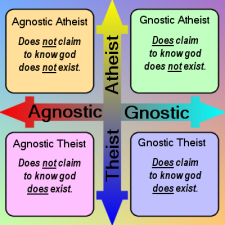
          Agnostic vs gnostic is a measure of certainty. As I previously said: You seem certain, and you are a theist. Therefore you are a gnostic theist.
          Unlike you, I wouldn’t pretend to be certain, and I don’t believe in a god. Therefore I am an agnostic atheist.

          Imagine a 2×2 grid like the following image:
          https://logosconcarne.com/wp-content/uploads/2012/10/belief-axes.png

          This is a common misunderstanding, and one that I, too, used to get wrong, so I won’t chide you too much for not knowing – But when I was getting it wrong, I wasn’t spending that time riding on my moral-superiority horse, either.

          The people you lack respect for (rightly so, in my opinion) is gnostic atheists – rare as they are – but it seems to go over your head that you, being a gnostic theist, are in the exact same position as they. Neither one of you have justified certainty, and yet you both pretend you do. And then you go even further by assuming people can’t be good unless they follow your god, and you say things like the following:

          the other denies all evidence and holds the claim of superiority as if he has searched the universe and found nothing.

          Change the last word to “God” and that’s you, my guy.

          However, If you are atheist then question one is:
          why are you here if you have already solidified “there is no God”. Why are you on this earth.

          Why did a pebble fall off the mountainside? There was no cosmic, divine reason. It doesn’t require one for the falling to make sense. That’s not to say that we, individually can’t find our own reason and meaning in the pebble falling. Our lives (clearly) can still have just as much or more meaning if it wasn’t ordained by a deity.

          The Bible is the most amazing book ever written.

          Setting aside the myriad of abhorrent morals in the Bible – some of which is under the direction of God, himself – it’s not even an internally consistent book. Like, with all due respect, Lord of the Rings is literally more internally consistent than the Bible, which is supposed to be the “perfect word of god”.

          https://philb61.github.io/

          There’s no argument that would sway what I have witnessed and been a part of.

          As a former Christian, I know that saying this makes you feel warm and fuzzy inside – but all it is is proof of what I have said before: You’re not interested in truth. You’re interested only in satisfying your comfort. It makes you feel good to believe God created the universe for you, that you’re divinely special, that you’ll live forever, etc, and you are therefore not willing to even consider the possibility you may be wrong. That is not what an intellectually honest, a moral, a selfless as opposed to selfish, a reasonable person does.

          And though he knew your heart would desire evil.

          He created my heart, didn’t he?

          Knowing does not mean he must interfere and make you a robot to be just.

          I don’t think you understand what I’m saying. It doesn’t matter how he knows the future. IF he knows the future, then you cannot act in any way other than what he has already seen, which means free will does not exist. You have no choice but to act exactly as God has seen. Without choice, free will doesn’t exist.

          You cannot see him without first believing in him.

          According to you: God created my brain from the womb, including all the synapses and neurons and chemicals, and he knew that my brain would be incapable of believing something without reasonable evidence. In other words: That it’s literally impossible for me to believe something without first seeing it. And yet, because he’s withholding what he knows would convince me from me and the brain that he gave me, I deserve infinite punishment in the lake of fire.

          That is childish rhetoric.

          You will never see him until you give up what you know and walk through that door.
          That is how it works.

          Pretty sure this is what the Branch Davidians also said. Or Scientologists. Or Mormons. Or Muslims. Or a host of the other 3000 estimated religions currently being practiced today. And your “evidence” is equally as compelling as all of theirs. Indeed, you all cite the exact same evidence: That “my life changed once I started believing” or “I feel my gods presence” or “I prayed and X happened”, or “I have lived it, tested it, read it, walked it.”. If these religious beliefs are all mutually exclusive – one is true means the others are false – this means that all of that “evidence” cannot be taken seriously. Must not be.

          What, therefore, are we left with to consider if we undertake an honest quest for the truth?

          We are left with observation of reality – none of which requires a god for explanation. Efficacy of prayer studies which show no correlation between prayer and health outcomes. Gaping holes in the logic in holy books. Hundreds or thousands of contradictions – both factual and moral – within holy books (like the Bible – see earlier link). We watch theists hand-wave away horrifying, unquestionably immoral things that their own gods allegedly commanded of their followers. We watch theists constantly reinterpret their own holy books every few decades to say whatever they want them to say in the current zeitgeist.

          What is the most reasonable position, given the above?

          That God almost certainly doesn’t exist, but not “certainly”.

          Like

        3. My friend, you don’t know the meaning of the words you are using.

          Atheist does not mean belief in absence. It is merely an absence of belief. Atheists lack belief in a god, theists have a belief in a god.Agnostic vs gnostic is a measure of certainty. As I previously said: You seem certain, and you are a theist. Therefore you are a gnostic theist.Unlike you, I wouldn’t pretend to be certain, and I don’t believe in a god. Therefore I am an agnostic atheist.

          Imagine a 2×2 grid like the following image:https://logosconcarne.com/wp-content/uploads/2012/10/belief-axes.png

          This is a common misunderstanding, and one that I, too, used to get wrong, so I won’t chide you too much for not knowing – But when I was getting it wrong, I wasn’t spending that time riding on my moral-superiority horse, either.

          The people you lack respect for (rightly so, in my opinion) is gnostic atheists – rare as they are – but it seems to go over your head that you, being a gnostic theist, are in the exact same position as they. Neither one of you have justified certainty, and yet you both pretend you do. And then you go even further by assuming people can’t be good unless they follow your god, and you say things like the following:

          the other denies all evidence and holds the claim of superiority as if he has searched the universe and found nothing.

          Change the last word to “God” and that’s you, my guy.

          However, If you are atheist then question one is:why are you here if you have already solidified “there is no God”. Why are you on this earth.

          Why did a pebble fall off the mountainside? There was no cosmic, divine reason. It doesn’t require one for the falling to make sense. That’s not to say that we, individually can’t find our own reason and meaning in the pebble falling. Our lives (clearly) can still have just as much or more meaning if it wasn’t ordained by a deity.

          The Bible is the most amazing book ever written.

          Setting aside the myriad of abhorrent morals in the Bible – some of which is under the direction of God, himself – it’s not even an internally consistent book. Like, with all due respect, Lord of the Rings is literally more internally consistent than the Bible, which is supposed to be the “perfect word of god”.

          https://philb61.github.io/

          There’s no argument that would sway what I have witnessed and been a part of.

          As a former Christian, I know that saying this makes you feel warm and fuzzy inside – but all it is is proof of what I have said before: You’re not interested in truth. You’re interested only in satisfying your comfort. It makes you feel good to believe God created the universe for you, that you’re divinely special, that you’ll live forever, etc, and you are therefore not willing to even consider the possibility you may be wrong. That is not what an intellectually honest, a moral, a selfless as opposed to selfish, a reasonable person does.

          And though he knew your heart would desire evil.

          He created my heart, didn’t he?

          Knowing does not mean he must interfere and make you a robot to be just.

          I don’t think you understand what I’m saying. It doesn’t matter how he knows the future. IF he knows the future, then you cannot act in any way other than what he has already seen, which means free will does not exist. You have no choice but to act exactly as God has seen. Without choice, free will doesn’t exist.

          You cannot see him without first believing in him.

          According to you: God created my brain from the womb, including all the synapses and neurons and chemicals, and he knew that my brain would be incapable of believing something without reasonable evidence. In other words: That it’s literally impossible for me to believe something without first seeing it. And yet, because he’s withholding what he knows would convince me from me and the brain thathe gave me, I deserve infinite punishment in the lake of fire.

          That is childish rhetoric.

          You will never see him until you give up what you know and walk through that door.That is how it works.

          Pretty sure this is what the Branch Davidians also said. Or Scientologists. Or Mormons. Or Muslims. Or a host of the other 3000 estimated religions currently being practiced today. And your “evidence” is equally as compelling as all of theirs. Indeed, you all cite the exact same evidence: That “my life changed once I started believing” or “I feel my gods presence” or “I prayed and X happened”, or “I have lived it, tested it, read it, walked it.”. If these religious beliefs are all mutually exclusive – one is true means the others are false – this means that all of that “evidence” cannot be taken seriously. Must not be.

          What, therefore, are we left with to consider if we undertake an honest quest for the truth?

          We are left with observation of reality – none of which requires a god for explanation. Efficacy of prayer studies which show no correlation between prayer and health outcomes. Gaping holes in the logic in holy books. Hundreds or thousands of contradictions – both factual and moral – within holy books (like the Bible – see earlier link). We watch theists hand-wave away horrifying, unquestionably immoral things that their own gods allegedly commanded of their followers. We watch theists constantly reinterpret their own holy books every few decades to say whatever they want them to say in the current zeitgeist.

          What is the most reasonable position, given the above?

          That God almost certainly doesn’t exist, but not “certainly”.

          Like

          1. If there is no God then there is nothing.
            If you come to an end and that end has nothing at the end of it, no matter how many words you add to it to try to make it something, the end is absolutely nothing.
            If you run a race and at the end there is nothing than you have run the race for nothing.

            Just because you say you do not believe, to be perfectly clear that is a belief and disqualifies itself.
            One cannot say they have no belief as that in and of itself is a belief.

            Faith in Jesus Christ is far greater than simply being a “theist”.
            Satan himself is a “theist”
            There are those that hate God. They are also theists.

            I believe specifically in the work of the God man Jesus the Christ.
            I believe also in the God who sent him.
            Jesus’ teaching states very clearly that unless one lets go of himself and lays down his life he cannot see God nor will he know the Sent One(Christ)
            I can and so state that factually God exists and also his Some did rise from the dead because I did as he asked and I can see him.
            I do not walk a path of doubting and searching for purpose as you do.
            I know beyond a shadow of a doubt because I have witnessed the Son of God and his power and I know him personally.
            Without faith you cannot, absolutely cannot see what I see nor can I prove it to you.
            You must our aside what you think you know and what you think you can prove and simply believe and the evidence is 100% revealed.
            This is why I am not the same as an Atheist.
            They have seen nothing yet they assume and call it facts.
            I am not simply a Theist.
            I am a child of the Living God.
            I am a justified Son of the God/Man Jesus.
            I am beyond any doubt going to be resurrected and live our eternity with the Maker of the universe.
            I am spiritual Royalty.

            The question is … do you know who you are and would you like to see what I see?

            Like

          2. You were never a Christian. You may have been religious. But you were never a Christian, you also do not understand the meaning of the word.
            You seem to have it all figured out and have settled into your position.
            I hope it works out for you.
            You can know him too.
            But what you are doing here is not the way.
            I’ve shown you the way.
            That is all.
            Good day.

            Like

        4. Sorry for double post – you can delete one of those. Site was messing up.

          Like

        5. Yeah, no. I was a Christian. Went to church, youth group, church camp, was baptized, read the Bible at home; I believed in your foundation:

          The foundation is this: Jesus died, rose from the grave, and offers life to all who believe. That is the gospel (1 Corinthians 15). Anyone who does not follow Him is not a Christian.

          You aren’t gonna gatekeep my experience, but nice try. I’m sorry it makes you uncomfortable to think of me as a former Christian but that’s another you problem.

          If you run a race and at the end there is nothing than you have run the race for nothing.

          This is an effective way to explain our different mindsets, so thanks for that:

          For some people, running is its own reward. You keep presenting counterarguments that are merely your own subjective insecurities and acting as though you’re making a point. I’ll say it again: Your comfort in an idea does not affect the veracity of that idea.

          One cannot say they have no belief as that in and of itself is a belief.

          Do I believe in God? No. Do I believe God does not exist. No. This is a bad take from you – likely parroted from some apologist you heard – and you just blatantly pretended that I didn’t correct you on agnostic vs gnostic, theist vs atheist.

          For clarity: Do you understand why I call myself an agnostic atheist and you a gnostic theist?

          I can and so state that factually God exists and also his Some did rise from the dead because I did as he asked and I can see him.

          Forgive me for possibly reading into this too much, but theists have done this same pattern to me too many times:

          From my perspective, our discussion started out with some interesting back and forth, where you were making some actual, if small, claims. I believe I have provided effective counterarguments to those I disagreed with, corrected you on your misconceptions, etc. And as the discussion goes on, you, with increasing frequency, ignore my counterarguments and corrections and questions and retreat into more and more fervent, over-the-top proselytization.

          To me, that reads as someone who is becoming increasingly aware that they can’t defend their views they are putting forward, and so they make fewer and fewer claims, while at the same time desperately trying to prove to their god how loyal they are. It comes across like Reek, in Game of Thrones.

          If that pattern I’ve seen a dozen times holds, I’ll give you your script – something I copied word for word from a previous theist debate: “I’ve only responded with what I believe the Lord wanted me to share with you. I already told you in the beginning that I’m not arguing with you. Have a wonderful day. If you want to know the answers to all your questions, I’m not God ask Him it’s His Word not mine.”

          Like

          1. Actually, if you are a true Christian, you cannot be a “former Christian.” That is a contradiction in terms. One cannot ever truly be a former Christian. All you are really saying is that you once practiced a religion that did not work for you.

            You were never a true follower of Christ. A follower of Christ takes up his cross and follows Him (Luke 9:23).

            Do you know what it means to take up your cross?
            In the days of the Romans, this was well understood—it meant you acknowledged that you were nothing, condemned to die, in need of redemption, and deserving of death for your crimes. It meant walking to the hill of judgment to die, and in that death, believing that He is your life (Galatians 2:20).

            When you are spiritually resurrected in Christ, you cannot go back and resurrect your flesh again (Romans 6:6–7).

            So, no—you were never a Christian. You made the same mistake when you identified me as a theist. I am far beyond that. Being a theist—the belief in a god—is the most basic thing one can discover. Everyone is a theist, even those who deny it (Romans 1:19–20).

            You have never died to yourself, because at this very moment you live and speak against the One who offers salvation. This is completely against the teachings of the One you claimed to follow (1 John 2:4).

            Jesus went to the cross. To be a Christian, you must also go to the cross (Philippians 3:10–11). Yet you still walk in the flesh? That proves you were never His (Romans 8:8–9).

            Right now, you are only religious—relying on your own intelligence to save you and justify yourself before Almighty God. You say, “Well, I don’t believe there is a God.” I’m afraid that is also a lie. There is no such thing as a true atheist—only those who suppress the truth and gaslight themselves so they can continue to be a god unto themselves, avoiding accountability (Psalm 14:1; Romans 1:21–22).

            Because your very first statement is a lie, I have no need to continue reading the rest. When you finally put “you” aside, and actually go to the cross, then we can talk. But right now, you don’t even know what that means, so you cannot possibly grasp what is right in front of you.

            I do not gatekeep. Jesus is the Way, the Truth, and the Life (John 14:6). He is the Gate (John 10:9)—and the gate is the beginning, not the end.

            Religion places the gate at the end, telling you that if you do enough, you may enter someday. Christ puts the gate at the start: the first step is surrender and faith, not the last. Once you walk through the true gate to eternal life, you do not go back, nor can you (John 5:24).

            Like

        6. “Actually, if you are a true Christian, you cannot be a “former Christian.” That is a contradiction in terms. One cannot ever truly be a former Christian.”

          “You made the same mistake when you identified me as a theist. I am far beyond that.”

          “Everyone is a theist, even those who deny it”

          “You say, “Well, I don’t believe there is a God.” I’m afraid that is also a lie. There is no such thing as a true atheist”

          “I do not gatekeep.”

          I appreciate you bringing it full circle and going back to our original disagreement, which was theists tendency to use flowery language even when it eclipses truth.

          You’re just saying things that make you feel good about yourself and your position – none of it has any logical, rational merit or truth.

          I didn’t say I am a true Christian. I said I was a Christian. And yes, you are gatekeeping. Funny you should bring up “gaslighting” in the same comment.

          Because your very first statement is a lie, I have no need to continue reading the rest.

          If you truly didn’t read the rest of my comment, that is very funny to me – considering that pattern I mentioned and your absurdly preachy, virtue signalling comment that followed my last. You could scarcely have done a better job at proving my point.

          (I think a more likely scenario is that you read it and couldn’t think of an answer to it, but sure).

          If I were less lazy, I’d make a graph of all the Bible verses you quoted in your comments over time. They seem to go up and up the more defensive you get – exactly matching the expected pattern – like terrified Reek desperately professing his desire to remain Reek when his sister tries to save him.

          Alright, man – I think we’ve wrung it dry. I don’t think any further benefit can come from continuing, though feel free to have the last word.

          Regardless of how it ended, I appreciate the discussion. It was fun while it lasted and I think we got some kernels of usefulness.

          Cheers.

          Liked by 1 person

        7. Oh, and one last thing: I made a post on my site of this conversation.

          Like

          1. I saw that. Thank you for your respect throughout this conversation, and I also appreciate your respect in your post.

            Addressing one thing: I believe that in order to arrive at a destination, one must know in what direction they are traveling. When it comes to knowledge, we arrive by asking the right questions (Proverbs 18:15).

            I believe the world consists of many parts. Simple words cannot suffice to answer the fullness of truth contained in the universe and beyond.

            Our world is made of many things—from the material, to the emotional, to the spiritual, and even the unseen realms (2 Corinthians 4:18). I believe the answers to all of these lie within our grasp collectively, and all align in one solid whole. To speak logically of such things and rely on words alone may lead someone to discover a single element of this universe, yet miss many others. To truly see what our universe is made of, one must align all pieces, and they must align perfectly and without error (Psalm 19:1–4).

            This is why I believe what I believe and why I see what I see, even when it seems that what I see eludes your vision. You spoke of “flowery speech,” but in our world, it is called art; it is called poetry; it is called philosophy—the very base of all knowledge apart from the spiritual (Acts 17:28).

            Shall we disregard the works of Shakespeare and others who have written beautiful words that strike at the heart of man? Both man and woman are swayed by such speech, and truth is often driven home through the language of song and beauty (Ecclesiastes 12:10). We cannot disregard these as unnecessary in the discovery of pure truth, if that is truly what you desire.

            All elements of the visible and the invisible must align. Jesus Christ is that alignment—He is the cornerstone by which all creation holds together (Colossians 1:16–17; Ephesians 2:20). There is no denying the power of this man Jesus, and there is no denying He existed without also denying basic historical truth. No credible historian disagrees with His existence.

            The Bible is the most-read book since the day it was compiled, and no greater work has ever been written. No book has sold more copies. While this may not prove its truth, it is a powerful witness (Psalm 119:160). If Scripture is thrown away for lack of evidence, then 99% of historical texts must also be discarded.

            To reduce the world to the material only is to prove oneself limited and blind to the deeper truths of the cosmos (Romans 1:20). Such a person is left with only a fraction of reality.

            I disregard elements of your arguments because they are not the right questions. The answers to them would lead us nowhere, and therefore, it is ineffective to spend time on them. (Proverbs 26:4)
            Jesus is the catalyst that drives your morality, you speak of your experience that led you to your moral compass but your experience happened in a world driven by the Christ and the morality he taught us.
            He cannot be avoided.
            Deny him as you will.
            He is still your God and one day you will see him as he is and you will be resurrected from the dead to stand before him.
            The question is not does he exist but rather are you ready to meet him and walk into the eternity you have chosen?

            Like

          2. I think you made yourself crystal clear.
            The facts of true Christianity are that there is, in fact, a gate. “I am the door; if anyone enters through Me, he will be saved” (John 10:9).
            There is a narrow gate. “Enter through the narrow gate; for the gate is wide and the way is broad that leads to destruction, and there are many who enter through it. For the gate is narrow and the way is constricted that leads to life, and there are few who find it” (Matthew 7:13–14).
            It is spiritual.
            I do not gatekeep—Christ is the gatekeeper, and He gatekeeps.

            You clearly stated that you were never a true Christian; therefore, your previous argument was the actual lie.
            You seem to need me to be defensive so you can defend your clear frustration.
            Scripture is the truth upon which I stand. “Sanctify them in the truth; Your word is truth” (John 17:17). It is the historical evidence that proves what I believe and the foundation of my moral compass. I do not argue from personal opinions or thoughts as if my opinions are truth as you seem to do, because that would make my moral compass subjective, and I would not be what I claim to be.

            Considering you spoke first in this conversation and now are bothered by my defense of your respectful yet verbal assault, it is clear that unless you are able to paint with a broad theist brush, your arguments have no validity but to argue with theists only is simply to argue with yourself.

            If seems that when you are required to address actual Christianity, you have no argument—which, when I was where you are, is what convinced me of its reality.

            The facts:
            • Theists are everywhere.
            • Gnostics teach false doctrine and lies. “See to it that no one takes you captive through philosophy and empty deception, according to the tradition of men, according to the elementary principles of the world, rather than according to Christ” (Colossians 2:8).
            • Christ is the gatekeeper, and He does and will gatekeep forever. “He will judge the living and the dead by His appearing and His kingdom” (2 Timothy 4:1).

            You must bow your head and recognize your position to even see the door, much less walk through it. “God is opposed to the proud, but gives grace to the humble” (James 4:6). Unless you do, you will never have any proof of what you seek and will spend your life searching for truth—only to find it when it is too late.

            It has been presented to you. To be a fake Christian, to practice religion, or to be a theist is to die still in your sin, just like an atheist oe any theist that rejects the Door(Christ). “Unless you believe that I am He, you will die in your sins” (John 8:24). So again to argue against any of the above is to argue against yourself, as they all believe they are the way to truth, just as you do. Those roads all lead to the same place. “There is a way which seems right to a person, but its end is the way of death” (Proverbs 14:12).

            Scripture declares: “I am the way, and the truth, and the life; no one comes to the Father except through Me” (John 14:6).
            Find Him and you find Truth.
            You are, in fact, being gatekept by the one you deny and not by me.

            Like

        Leave a comment

        Discover more from The Unseen Thread

        Subscribe now to keep reading and get access to the full archive.

        Continue reading